Showing posts with label reading. Show all posts

February 2, 2013

Reading on


Halfway through Jared Diamond’s latest, The World Until Yesterday, I am not as enthusiastic about it as I was with Guns, Germs and Steel or Collapse. In the latest book he is comparing earlier kinds of societies—hunter and gatherers, herders, and so on—with WEIRD societies. WEIRD has to be an ironic acronym and stands for Western, educated, industrialised, rich and democratic. He is suggesting that there are things we today could learn from some of  the ways things were done back then. It rather inhibits the telling that there are so many variations even among societies of the same kind, that there are a lot of qualifying of statements. But there is interesting information about things like warfare, and childrearing, and I suspect there will be more of interest in the coming sections on health, religion and language.

W. G. Sebald’s Vertigo was published in 1990. He’s a favourite author of David Foster Wallace and several other writers I like so I decided I’d better read him. This one, chosen randomly from those available from the Wellington Public Library, is four linked stories about men traveling, (mis)remembering, being in a state of greater or lesser anguish. Sebald’s theme, according to the blurb, is “the vertiginous unreliability of memory.” I was not entirely gripped by any of it. Resolved to try another of his books before too long.


A.D.Miller’s Snowdrops is a bleak tale that I enjoyed a lot. It’s set in Moscow in the mid-oughties. The protagonist is an unappealing expat banker who loses his “moral compass” and allows himself to get involved in two scams of very different scale. It’s written as a confession to his fiancĂ©, whom he met after the events of the book, and he says he thinks she may not marry him once she has read the story. I won’t spoil the story and quote it, but the last sentence seemed to me the most likely to provoke that reaction.

I’ve been a James Meek fan since he came  to Wellington Writers’ and Readers some years ago, and I read The People’s Act Of Love, a grim and complicated story about how to live a moral life. Meek’s latest, The Heart Broke In is a ramble of a book with many characters and time shifts. It’s about becoming part of the long-term stream of life, for example, by having children or doing science. It also deals with love and betrayal and guilt and self-justification, especially through the vile, self-serving celebrity, Richie.

Richie tended to divide his memories into two categories: things that happened to him and things that happened to other people while he was there.

The idea that modern life lacks a moral compass features in this book, too. A key idea seemed to me to be the question of how to be moral without religion. Maybe.

November 20, 2011

Recent Reading

In my last post, I promised another one soon about some of what I have been reading. Here it is.

I’ve had a Henry James jag, reading four of his twenty or so novels. Portrait of A Lady was my first read and my favourite. Isabel, its protagonist, wants to be an independent, free-thinking woman and to be good, by her own lights, which means authentic and real. Of course this is doomed in the long term. But how interesting for a protagonist of that time (pre WWI) in a book by a man to be so concerned with her own identity. This carries into The Wings of the Dove, about another independent, rich woman, this one ill.


The protagonist in The Ambassadors is male, though concerns with authentic identity, and an authorial focus on introspection rather than plot, remain. There is plenty of plot in all these books, but it is almost secondary to the characters’ thoughts about themselves, their motivations and their relationships. The same applies to The Spoils of Poynton, the fourth book of my James-jag. Of course, he is much studied and discussed in sophisticated ways I don’t even touch on here, and he writes beautiful sentences.

I think Julian Barnes’ The Sense of an Ending is a worthy winner of this year’s Man Booker Prize.
It’s a novel that deals with the complexities of memory, and how we reinvent and reinterpret our past actions. It’s beautifully written. I hadn’t read any Julian Barnes before and now I will.

Carol Birch’s Jamrach’s Menagerie was also short-listed for the Man Booker. It’s a good read, but harrowing in the gruesome details of harpoon-whaling and a long lost-at-sea stretch . Jaffy, in whose voice the story is told, is on the whaling ship as one of a small group of men seeking exotic animals for wealthy collectors in England at the time.

Michael Ondaatje’s The Cat’s Table is set largely at sea, and is written from the point of view of a young person, but those are the only similarities with Jamrach.
Three unaccompanied boys meet by being sat on a passenger ship’s most lowly dining table on a voyage from (then) Ceylon to England. The story is told by Michael, looking back. There are flashes forward to his later life, but the action of the story takes place on the ship. Great writing, great characterisations, great insights from the point of view of the young Michael.

My son lent me The Watchmen, a (mostly) graphic novel (is that the right word?) written by Alan Moorhead, with visuals by Dave Gibbons and John Higgins, first published by DC comics in 1986. This is satire at its best.
I had to concentrate hard to follow what was going on, but it was worth the effort. Graphic novels require a different kind of reading from straight text. I’m not sure what exactly that difference is, and have never read anything about it, but suspect it’s got something to do with paying as much attention to the images, and how they are arranged, as to the words.

I picked up Marilynne Robinson’s Absence of Mind because I so admire her novels. Absence of Mind consists of four essays in which she argues, more elegantly than I can say it, that “mind” (introspection, belief, self-consciousness and so on) is more than “brain”. It’s a dense and fascinating read. She argues for “…the odd privilege of existence as a coherent self, the ability to speak the word ‘I’ and mean by it a richly individual history of experience, perception and though.”
There is, she says, a human mind and consciousness that is more than can be described by closer and closer descriptions of the human brain. This is a fascinating book that I will read again.

Over the summer, I plan to read David Foster Wallace.

August 5, 2011

With a knee operation and subsequent bad reaction to medications behind me, I am now back to reading and at least thinking about writing and publishing.

I'm stumbling along with The Brothers Karamazov, finding it, well, overwrought. Am also noticing how contemporary some of its concerns are and actually improving my understanding of what christianity/religion can mean to people, mainly through the character of Alyosha, the youngest brother. So I’m far from giving up on it, but reading other things alongside.


Re-reading Sarah Bakewell’s How To Live: A Life of Montaigne, is a delight. Bakewell is most impressive in the way she brings together historical context, what is known of Montaingne’s life, his reading and influences, and of course the ideas in his Essays. His ideas about how to live are worth thinking about, though at times I get annoyed with them.


J.M.Coetzee’s Diary of A Bad Year runs three versions of itself across the pages. Along the bottom of each page, separated by a thin line, is the story of a (not overtly sexual) relationship between an aging author and a woman in the same apartment block who types up the manuscript of a collection of thoughts he is writing. Starting a little way into the book is another stream, from the woman’s point of view. Across the top half - and more - of each page are the ‘thoughts’ of the author. I decided to read one strand at a time, starting from the one at the bottom of the pages, and this worked for me. As did the whole book. I admired it and enjoyed reading it and found the ideas of the short essays interesting, particularly the early ones about the state and the succession of power.

I’m finding it hard to think about the publishing of the new novel. There’s still a little editing to do, but that’s no reason to not at least settle on the beginnings of a plan. (Made a phone call to a friend, got more energised, watch this space.)

It seems a long time since I wrote anything new. There are a couple of ideas in there somewhere, I need to shake them out and see if they go anywhere, which means settling down at the computer and getting some words down.

I have written up the China travels, with photos, and put the file up on the web. You can access it at
http://dl.dropbox.com/u/766517/ChinaTripDB.pdf
without having to sign up for anything or identify yourself.

Tian'an Men Square, Beijing.
There’s no way to comment, if you want to make a comment come back to this blog or email me.

July 10, 2011

Not a travel blog

While traveling in China I did little reading and no writing. It takes a lot of energy to travel, especially when you don't speak, read or write the language and it is very very hot

There were sights to delight and amaze, beauty to revel in , history to wonder at, and experiences to cherish, along with a few times when it was overwhelming, and that not in a good way.


And there is nothing like walking on the Great Wall with a crowd of Chinese tourists, thinking about the history and the lives lost in its building, and the invasions from the north that it was built over time to counter. It looks like the pictures, but being there is something else. Thirty-five degrees-plus temperatures put shade at a premium and I wasn't the only one using my umbrella to create some.

At the other end of our trip in more ways than one was how they hang out their washing in the lanes that run along the canals of Suzhou. Pagodas, gardens, temples, street scenes, food - there is so much more I would say if this were a travel blog.


Once the further impediment of a knee operation is behind me I have resolved to get moving on the project of publishing, one way or another, my latest novel. And new writing to do. And reading. I'm well into The Brothers Karamazov, with a pile-in-waiting, so my next post will be back on topic.

April 26, 2011

Learning from the Best

Three of the seven publishers I sent queries about Where The HeArt Is have said no, the other four are yet to respond. I am not entering the slough of despond about this, have decided to not think about it until we get back from a June trip that edges in to July. So, in mid-July I'll think about what next with it.

Which then reminds me of re-reading Orhan Pamuk's My Name is Red because I have been reading a series of lectures he gave recently about writing. He's one of my favourite authors, and I also like what he writes about writing. I had forgotten things about My Name is Red, like the awful

way the apprentices are treated, including being sodomised by their “masters.” I was, however, fascinated all over again by the miniaturists of late fifteenth century Istanbul and how they ply their trade and deal (or not) with influences coming in from Europe. It’s a fascinating book on a number of levels.

The online reading group has finished Dostoevsky's The Idiot and started on Demons (also known as The Possessed) next week. If you want to join in, go to http://projectdblog.wordpress.com/ The writing in The Idiot was somewhat overwrought for my taste, but I did get into it. D's issues are big ones that remain relevant, like what does it mean to be "good" and how society and the individual influence each other, and so on. Here are

some choice phrases to illustrate my designation "overwrought: "exclaimed with spiteful vexation," "said impatiently and wrathfully," "grinned bitterly and sarcastically." The word "wrath" (and its derivatives) is used over and over; I'll be looking out for it in Demons. And I noticed that Pamuk uses "wrath" several times in My Name is Red. Mind you, the latter is set in 1491 Istanbul, it would be harder to use in a contemporary setting but what are the odds against me giving it a go sometime soon?

I’ve started Jennifer Egan’s A Visit from the Good Squad, which is causing a stir on bookish bits of the internet, and just won the Pulitzer.

The best commentary I have seen on it is at the New Yorker Book Bench, which you can access without being a subscriber at http://www.newyorker.com/online/blogs/bookclub/

I am playing around with other kinds of writing. I did an exercise involving analysing a short story and writing one to reflect it in several aspects. I chose a Lydia Davis story, and as she doesn't do plot in a conventional way, I had to selectively follow the instructions. The story I wrote myself is inconsequential, but it feels as though it was a worthwhile thing to do. Nowhere near as good, of course, as Lydia Davis. I am reminded of the way artists used to — maybe they still do — learn by making copies of works by famous painters.

Here’s the story I wrote after examining the Lydia Davis one. I am encouraged to show it by the fact that the other members of my writing group liked it. I have incorporated their excellent suggestions. I’ve been thinking about the writing group and how it works a lot lately and will write something about it and take it to our next session and see how other members feel about me publishing in here about it.

The Visit
Dad asks how my studies are going and I say "Good," which is partly true. There's no way I could explain to my father the ways in which they are not going well. It would take forever, and he wouldn't understand anyway. So, good is the right word and doesn't tell the half of it; I could never explain how having my mother's piano would make a difference to addressing what my teacher called "the emotional void" in my "technically excellent" violin playing.

Wanting something from an elderly parent is difficult, especially when the something you want is emotional for you both. Joe has come to support me but he doesn't understand why it's so difficult to ask. In his family they just ask, and people just say yes or no and that's an end to it. Also, I we have different ideas about all kinds of things, like sometimes I think he's shouting and tell him to stop and he is surprised and bewildered. Shouting makes me curl up like a quivering ball inside.

Joe told Dad a funny story that happened at his work and that made us all laugh. Everything felt less tense and that meant it was a good time for me say what I wanted, but I was enjoying feeling more relaxed and didn't want to spoil it. Then Dad started one of his stories from the old days and he kept referring to me and saying that's how it was, wasn't it girlie, and I would say yes. When Dad opened the photograph album on the coffee table, I felt Joe looking at me intently and I knew he was sending me a message to get on with it. I was getting on with it. Joe like sthere to be a straight line between things, the shortest route you might say.

It wasn't long before Dad had to pee and he said he'd put the jug on for a cuppa while he was up. I said I would help (I didn't want him carrying hot cups) and went into the kitchen. Joe followed. Of course he wanted to know why I hadn't asked yet, and I said I had to do it the way we did things in my family. He shrugged and noticed how dirty the kitchen was and got down some cups and washed them thoroughly.

Dad came into the kitchen and said he'd make some cheese and crackers. We said no need and Dad got the sulks and went on about how he could still make sure we didn't do the drive home without eating something and he knew it was no good inviting us to supper so the least we could do was have a snack before dealing with the motorway. He had some gingernuts somewhere too. Joe said all right then. I knew he was trying to do things my way. I got down a plate and washed and dried it. They both looked at me as though I was being a fusspot then looked at each other and smiled.

Getting us something to eat had cheered Dad up; he positively bounced back into the sitting room and let us carry everything, forgetting about the photographs and the old stories. He and Joe started a conversation about the cricket and Joe said he thought South Africa would take the World Cup and Dad said, no, India, and they chatted away about spin bowling and slow wickets and short outfields and I didn't say anything. Neither of them gave the Black Caps a chance. While they talked about the failures of New Zealand Cricket to bring through young players, I watched the dust particles dancing around in the sunlight, and thought about getting a cleaner for Dad and how to get him to agree to that. But not today, there was something else today.

For an hour or so the two of them talked sport and I practiced what I would say in my head. And wondered whether the itches around my ankles meant there were fleas. The conversation between the two men drifted to a close about when I was thinking that probably half the people in the world liked talking about sport and half didn't.

Then I asked. And Dad said yes right away. He hadn't played a note on that piano for years, of course we could have it moved to our place. Dad and Joe got to talking about carriers and arrangements.

I thought about how the afternoon had started off with me and Joe on a mission to get something from Dad, then shifted to me and Dad and the past, with Joe on the outside, and again to Joe and Dad and the plate then the cricket, and when I asked it was easy, and Dad never said a word about how much that piano had meant to my mother and that straight lines weren't always the best way to go.

March 7, 2011

Truth, writing, reading, rejection

"The paradox of the arts is that they are all made up and yet they allow us to get a truth about who and what we are or might be." Seamus Heaney in Finders Keepers, Selected Prose 1971—2001
A conversation with my son has me thinking about truth-telling and how a poem, a song, a story, can carry truth that has not much to do with relating a string of events. I think maybe it's more than a paradox, it's a glory of the arts that they "allow us to get a truth." Like a truth of the tragedy of my sister. The week in which this conversation took place had been a medically dramatic one, culminating in my having a pacemaker inserted; hence, in part, the gap between this blog entry and the previous one. All, as they say, is now well.
Writing, however, has flown out the window and left behind a dearth of ideas and inclination. Fortunately, I believe both will return, and to help them along I have gone back into my journals of the last couple of years to see what I have recorded from what I have read and what notes and observations I have made. That's where I found the Seamus Heaney quote. I've pulled out Heaney's book of prose writings to re-read.
As I read Dostoevsky— currently near the end of Part One ofThe Idiot—along with an internet-based reading group led by Dennis Abrahms (http://projectdblog.wordpress.com/) I wonder about Dostoevsky's overblown prose and characters who seem to stand for ideas or aspects of Russian society and life. He is such a contrast to my own pared-down writing about characters in their everyday lives that, in my mind, stand only for themselves; examples of the human condition, if you like, rather than exemplars. I'll have a go at writing a few Dostoevskyian paragraphs, paragraphs that are unlikely to ever see the light of day, but I might learn something from at least trying to write in such a different way.
Here's how my reading goes sometimes, in a process I really really like. I'm reading Dostoevsky, along with DA and co, and in a London Review of Books see a review of a book called The Possessed: Adventures with Russian books and the people who read them By Elif Batuman, of whom I have not previously heard. So now I am reading that and enjoying it a lot and wondering about having a go at reading one of her subjects, Isaac Babel, who I have never read before. I'll try a library copy first.
I've had three rejections from publishers I have submitted my novel to. The last one was a clearly non-standard letter. It stated clearly they wouldn't publish my book, said they don't give feedback and suggested three other publishers (I've already been rejected by one of those.) It was a good letter; straight-forward, with a tone that was neither patronising nor dismissive. I appreciate that.

February 3, 2011

Books, books and a new project

On the subject of querying publishers, things are proceeding slowly. Various life events have intervened, including a dead internet connection for three days. Four queries have been sent off, there are three to go. Each one takes about three hours, by the time the synposis, letter, bio and so on are adapted to each publisher's requirements. It's a shade less aversive than marketing/promoting an actual book, so I am doing it, and will continue to the end of my list.


I'm still reading 99 Ways Into New Zealand Poetry, by Paula Green and Harry Ricketts and still enjoying it and continuing to be most admiring of how much they know and how they put it together.


The great birthday pile (see photo above) is as exciting as ever and promises much excitement and many treats. An early one is The Torchlight List: Around the world in 200 books by Jim Flynn. This is a small attractive book that takes a thematic look at how to get an education about the world, through reading great literature. Some extracts from his opening:
"I want [people] to be able to understand the world, rather than just be swept along … with no real comprehension of what is happening to them. … you need to know something about science, and nations other than your own and their histories, and the human condition."
The 200 listed books are supplemented by sublists. Counting from just the 200, I find I have read 39. Is that good? Or bad? I don't know, and it doesn't matter. It is illuminating to see where my gaps are - I have read few books about Spain, Portugal, South America, for example. Jim Flynn gives pithy descriptions of the books he lists and his own candid opinions of them. It was fun to read.
Now I'm onto my next writing project, which is gathering together short pieces I have accumulated over the years that I may be able to shape into some kind of collection. I fancy having 60 in total, which means writing some new ones, but I'll do the gathering first and see what I've got. Here's an early draft of what could possibly be the first piece in the collection:
An Opening
He was twenty-two when he died, a soldier in another country’s army fighting a different country’s war in yet another country, felled by support fire from a friendly gun. A full military funeral was called for, and held in the country of his origin, though that country was none of the earlier ones mentioned.
Family members flew around the world to bring his body home and his coffin sat in his parents’ living room for two days.
“I thought they usually had the coffin open,” said someone.
The funeral was a stage-managed affair on all fronts, at all levels. His sister bought some expensive high-heeled shoes in bright yellow, especially to wear with her short black skirt and tight black top. The family is well-connected. The army is well-connected.The funeral was in the cathedral. Joint ops. Lies were told about the man who died. Well, not outright lies, but that combination of exaggeration and omission that make someone look better than they were.
A woman was there who had no business being there, except she cared about an extended family member who would be there and perhaps sidelined. As one who did not believe in any god, she had not been to the cathedral before and admired the colours in the stained glass windows. Between the karanga calling in the coffin and the trumpet playing of the last post as it was carried out on the shoulders of slow-marching soldiers there was no tangible emotion, except for a stranger sitting beside her, who sobbed quietly throughout and appeared to know none of the family.
During a reading of verses from Ecclesiastes, widely known through a Seekers’ song, a gentle pop in the mind of the woman who had small business there turned into an idea for making a whole bunch of her short writings into something real and formed; “stones gathered together.”

December 22, 2010

About reading

I like it when one thing leads to another. For example, Lorna Sage’s Moments of Truth, which was recommended to me by a friend, reminded me of Angela Carter. I have a couple of her books from the eighties, so I reread the collection of her reviews, Expletives Deleted.  Here's a great sentence about American folktale collector Henry Glassie of whom I had  not previously heard: “He is grievously afflicted with fine writing.”

I’ve also got her book The Sadeian Woman which I remember being bewildered by back then. I know more about the surrealists now, who Carter was interested in/ influenced by. Until, that is, as she says in Expletives Deleted,

… I realised that surrealist art did not recognise I had my own rights to liberty and love and vision as an autonomous being, not as a projected image, [so] I got bored and wandered away.

Another connection is with the novel-known-as-Ann where the idea of folktales comes up and it is useful to be reminded of Carter’s interest in them.  While I didn’t know all of the writers she reviewed, I enjoyed Carter’s writing so much I’ve put her on my list of novelists to seek out at the Wellington Public Library.

 Some time ago I became aware of recurring mentions of the essays of Montaigne. I’ve forgotten where, but I picked up an Everyman edition of them in three volumes from a second-hand bookshop and have delved in here and there. Then I noticed reviews of a book by Sarah Bakewell, How To Live, or A Life of Montaigne in one question and twenty attempts at an answer. Thanks to my good friend, the Wellington Public Library, I have a copy to read over the holidays. Three chapters in and I’m fascinated.

One of Montaigne's answers to the question, "How to live?" is, "Read a lot, forget most of what you read and be slow witted." I haven't read that chapter in Bakewell's book yet, but I think I'll like it.

My other reading just now is Peter Hessler’s Country Driving, his latest about China. More on that when I’ve read more. And then there’s Barbara Kingsolver’s Lacuna  to re-read for our January reading group session.


November 11, 2010

Editing again, more reading & Out To Lunch

I printed out the ms of the-novel-known-as-Ann and right away I’m editing again. Those damned sentences keep jumping out at me demanding a tweak. This time, though, I’m starting from the final chapter and working forward a chapter at a time. I figure the early chapters have had much more attention - apart from anything else they’ve been around longer - so this time I’m walking backwards for (not christmas, never!) - well, page 1 guess. It’s way beyond me to work backwards at a page level, so I’m starting at the first page of each chapter and working to the end of that chapter, then starting the first page of the previous chapter. Never done this before. I wouldn’t try it if I didn’t by now know the story really well. 

The reason I printed it was for reading by some Auckland friends we are visiting soon. These friends read the short story this novel/novella arose from, over a year ago. At 52,000 words it’s short for a novel and long for a novella, so I don’t know which to call it. What I do know is that it’s the right length for the story that it is, so will not be messing about with that.  I’m still thinking about the pieces of writing that might go with it I referred to in my last post and whether I can assemble a book from them plus Ann.

I read about Japanese writer Kenzaburo Oe somewhere and have forgotten where, but I got one of his many novels from the Wellington Public Library. It's title is Rouse Up O Young Men of the New Age! and it's about a writer and a son who was brain damaged at birth. The protagonist is also studying the poet William Blake and using Blake to interpret his world, although he, the protagonist, is not christian like Blake. The title is a quote from Blake.  I found it strangely fascinating. Lately I seem to be coming across a lot of books with a protagonist who is kind of the author and kind of not. For example, in the acknowledgements to The Shadow Catcher Marianne Wiggins thanks her sister for, “permission to decorate our shared history.” And there are whole books written about Marcel in Proust’s In Search of Lost Time and The Narrator and Proust himself and how separate they are, or not.

We took A Cynthia Osick Reader to Australia last year and never got to read it. Stimulated by news of a new novel from her, Foreign Bodies, I have started it. Issues around being classified as “a Jewish writer” — and hence of interest only to Jewish readers and a standard-bearer for Jewish culture— are a feature of her career, and the editor of this collection from her writings, Elaine M Kauvar, says of this, “No imaginative writer, whether or not she is Jewish, sets out to write a novel to become a spokesperson for a group of people or to become responsible for its culture.” As a lesbian who writes fiction, often with lesbian characters, I heartily agree with this.

Out To Lunch, the book of writings by the writing group I am in, is being printed as I write. We’ve seen a proof copy and everyone in the group is happy with how it is. It’s a good project to be involved with. Here’s an extract from the introduction.

Our meetings are long chatty affairs where we workshop our writing. There's praise and encouragement and many helpful suggestions, and a shared lunch. Food brought to share reflects the bringer just as the writing offered reflects the writer.
Writing without the endpoint of publication becomes unsatisfying after a while. You need an audience, to complete the act of communication. At one of our meetings, we talked about publishing.
“It’s nice,” said Annabel, “to put something out there, not just write into a vacuum.”
“We can give lesbians something about themselves to read,” said Kate.
“It’s good to have things for women who haven’t come out,” Terry added.
Pat thought it would be good for everyone to be involved in a project doing the nuts and bolts of publishing. Judith agreed with all of this. Kate applied to the Armstrong Arthur Trust for some money on our behalf and we were successful.


October 18, 2010

More reading than writing

There's more reading than writing going on here just now. I'm still editing the novel-known-as Ann and did some research in the library the other day, which involved reading Dennis Glover poems in the New Zealand section. He sure wrote some odd poems as well as some terrific ones. I think he had a talent for making unlikely rhymes work. It reminded me what fun doing the research for writing can be when you get off the internet. (Not that the internet isn’t most useful for research.)

My recent reading has involved some heavyweights as well as catching up with New Yorkers and copies of the London Review of Books from when I was away. (Interesting issue about plurals here, which I avoided. I suppose it would be London Reviews of Books. Or not. Or LRBs to cop out.)

The Books
On Being Ill by Virginia Woolf, reprinted by with an introduction by Hermione Lee. A small book, but perfectly formed, with a facsimile of the original cover by Vanessa Bell. (I was going to add a photo of the cover but blogger has changed something and what was really simple is now impossible unless you have files on picasa, which I don't. Grrr.)
Room by Emma Donohue. Shortlisted for, but not the winner of, the Man Booker. A compelling read of a book that is my book group choice so I can’t say more until after we have talked about it.
Freedom by Janathan Franzen. This book is being much-discussed on a number of the erudite blogs I read and was reviewed in LRB. I think it’s a dish with too many ingredients, used too cleverly by half; kind of up itself. It has many characters, much plot, and a large bunch of issues. The theme about wanting to be a good person was one of the most interesting, and ‘goodness’ or lack of it was a big deal for the three main characters, Walter, Patty and Richard, who were all in love with each other one way and another. Another theme is that of title - what does freedom mean, if anything, in America today? It’s clever and very contemporary and has some very quotable sentences, such as: “When you think about it, for a mature organism, growth is basically a cancer, right?” So why didn’t I like it more? As the LRB reviewer pointed out, there’s a lot of sobbing
Self by Yann Martel. He wrote this way before The Life of Pi, which I loved. It’s a self-indulgent, memoirish, sort of travel book and I didn’t finish it. That hardly ever happens.
The Finkler Question by Howard Jacobsen. This is the one that did win this year’s Man Booker, against the odds, literally (the UK bookmakers stopped taking bets on another book). I’m only a little way into it, and it’s challenging and takes concentration and even then I think I am missing a lot of allusions. And yes, it is funny. And it is shaping up to be well worth the effort.

Out To Lunch the book of writings by my writing group
We meet on Sunday and will plan the launch in late November. There’s varying degrees of excitement and nervousness among group members. I’m enjoying working with the group on the project.

Nanowrimo (write a first draft of a 50,000 word or more book in the month of November) is about to start. I’m not taking part this year. Doing it last year was how I turned a short story into the-book-known-as-Ann. There are thousands signed up worldwide and over a hundred from New Zealand. Online forums and various encouragements are on the website all the way through the month. Here’s the link if you want to find out more: http://www.nanowrimo.org

July 28, 2010

More reading, some writing

I’ve been reading some writers who write very differently from each other as part of my search for ways of writing that I find satisfying for myself.

I forget what the references to it were that made me interested in Thomas Bernhard, a dead Austrian who wrote in German. His last book, Extinction, which I got from the library, is 326 pages in two paragraphs, one for each section. It took a while to get used to reading pages without any paragraph breaks, it gave the whole book a relentless feel. The setting is largely inside the protagonist’s head. He spends the first half ruminating about the family he hates, having just received a telegram from one of his two sisters saying his parents and only brother have been killed in a car crash. The second half is still in his head but he is physically at the family estate (they are rich). He thinks everyone despises and judges him, as he does them. There are hints that he is an unreliable narrator, as they say. He rails against the action of Austria the country and Austrians the people in WW11. Looking back I am surprised at how much I enjoyed reading it, mostly over several train trips to Wellington. I’m not going to give up paragraphs.


Lydia Davis’s Collected Stories is another matter altogether. Short stories, some a few lines, some a few paragraphs, others several pages. Written over xx years. Again, mainly from inside people’s heads but many different point/s of view and voices. A lot to do with mothers, both being one and having one. The reviewer in London Review of Books (22 July) calls them, “uncomfortably intimate.” Apart from one of the longest stories, which I didn’t get at all and thought boring, I loved reading this book, too. What have I learnt about my own writing? I don’t know, that’s something I find impossible to articulate. I certainly don’t want to write ‘like’ people I read but somehow reading the kind of writing I don’t do informs what I do.


The third book in my recent exploration is Lorrie Moore’s A Gate at the Stairs. This is a writer who wallows in words, the sound of them, the meanings of them the mis/use of them. It’s a grim novel, with a lot of sub-plots, and it’s funny.

At least part of the impetus for this reading has been Francine Prose’s Reading Like A Writer, (Must read one of her novels.) which I referred to in an earlier blog.

I’m still flopping around with my own writing. Need some discipline to get the latest draft of the novel finished and have some people who read the early chapters read the whole thing. I have some short stories on the go, one of which used to be a poem. I took this to my writing group on Sunday and thanks to their feedback it’s improved a lot. See the end of this post for its current version. Might be a final version.

The writing group is in the throes of publishing a book of our work. More on that in my next post.

Between
On the anniversary of her daughter’s death, she walks to the southern end of the beach, well away from the day-trippers.

Between the rumble of the train
and the waves’ reiterating roar.


She watches two oyster-catchers feeding at the mussel rocks. The afternoon looms appropriately grey, with the hidden sun now and then sheeting arrows of light through gaps in the clouds, making the waves’ white tops flare. A man fishes from the shore. A child climbs the skeleton of a tree dropped on the beach by a winter storm. Last week it had been further along, now it’s lodged in the sand like a climbing frame. She wants that child, whose mother sits on the sand with her knees pulled up to her chin, her arms wrapped around them, watching; the job of all mothers.

Oyster-catchers fly off at the skittering approach of a small black dog. The pied shag drying its wings on a rock scares into flight. The waves come in, the waves pull back, the sun’s rays are shining, then not, birds eat, preen, fly off, bent on their own safety. All are careless of her desolation and she finds a strange solace in their indifferent beauty.

A man approaches, running behind a push-chaired baby, smiling as he guides the three-wheeled buggy in a semi-circle around her and heads back the way he came. Her eyes fill with tears. She laughs, at his heels flicking up sand.

June 24, 2010

why write? why not read?

Why write? It’s the ongoing question. Sometimes I bore myself thinking about it, so I try not to think about it and just do it. Today it popped out of hiding as I was thinking about writing a new blog entry. “Because I have to,” is a silly answer, though it often enough comes to mind. Maybe it’s really, “because I want to.” If I want to I must think I have something (worthwhile) to say. What could that be? A particular way of seeing the world, perhaps. Maybe I read books by writers who write about writing in search of a better answer.

The daily writing diary has been stop-start jumpy. Days when I forgot, others when I just didn’t do it. Being sick with a cold was a credible excuse for only a couple of those days. Still, rambling away to myself about what I am writing — and not — is something I will carry on for July. Along with a new spurt of editing the novel that keeps slipping into the background.
I found and bought a second-hand copy of Strunk & White’s Elements of Style which I mentioned in my earlier post. Its “do this” and “don’t do this” approach is an antidote to a lot of writing about writing on the web, which is kind of wishy-washy.

Novels made it back into my reading. Alison Wong’s When The Moon Turns Silver, Paul Auster’s New York Trilogy (three short novels from the eighties), Lorrie Moore’s A Gate at the Stairs.


And a bit of new writing:

…the other side…
I try not to envy Maria. She’s my best friend, after all, and envy is such a corrosive emotion, not too many steps away from resentment, and you can’t be friends with someone you resent. Married to maybe, I’m sure many are, but not good friends with.

We’ve known each other for forty years, Maria and I, been through a lot together — my illness, her divorce, the horror of her son going into the army, the SAS, no less. Not to mention various financial crises, forced house sales, teenage children in various kinds of trouble. All history now. We talk sometimes about how things we lived through, like the ’81 Sprinbok tour and the bombing of the Rainbow Warrior, are the subjects of documentaries about the past. “That’s not history, that’s my life!” we want to say.

We haven’t always lived in the same city or even country, but it never stopped us keeping in touch. How old-fashioned writing and posting a letter with a stamp on it seems now.

It’s so easy to be romantic about something that isn’t and won’t be available to oneself, so easy to think “it must be wonderful to…” and it wouldn’t necessarily be, on a day to day basis,j so wonderful in its happening. But I do envy. Oh, I have my laptop, bless it, that takes me out and about in the world, but it’s not the same as living, as they say, in the bosom of your family.
“Here you go, Helen, here’s your call from Adelaide.” They’re very nice the staff here, mostly from the Pacific Islands, quietly spoken and pleasant

“Hello Helen, it’s so good to hear you.” Maria sounds tired. I can hear her grand-children in the background, arguing with their father by the sound of it. “That’s just started up. I’ll go into the other room and close the door.”

June 1, 2010

More writing, editing and reading

Story A Day May is finished. I posted 29 stories in 31 days. See one at the end of this blog entry.

Have finished the tense-edit of the current novel. One more chapter to write, this time with some of the early story of the mother, Shirley. I’m avoiding thinkng about what to do when it seems finished — apart from having Prue and some others read it. Publishing is an odd beast at the moment, with the big print-publishers looking for fashionable writers who’ll sell vast quantities of books and epublishers talking themselves up like mad and neither side really knowing anything about the future.

I just read an excellent book, Reading Like A Writer, by Francine Prose, a novelist with fourteen published novels, none of which I have heard of let alone read. It’s sub-title is, “a guide for people who love books and for those who want to write them.” She recommends Strunk and White’s The Elements of Style from way back and reading and analysing the best of writers, with lots of examples from Raymond Chandler to Chekhov. Katherine Mansfield is in there, and Gertrude Stein.

What now for daily writing? A writing diary I think, which may include bits of writing. A sort of keeping tabs on myself, not something to show people or put online. I’ll try that for a month and see where, if anywhere, it goes.
And it’s definitely time to read a novel.

Here’s the story:

June
June had been born in July and was grateful to have been named for her maternal grandmother and not the month of her birth. When she had suggested to her Uncle August that he could use his second name, the harmless John, he’d told her that his father had called him August and that was good enough for him, thank you. June was accustomed to her helpful suggestions being taken the wrong way. It was only the other day at work when Nigel had complained, yet again, about how put upon he was and how Keith and Shona took it for granted that he would clear away all their coffee mugs and she had said, ‘Leaving them there is a good alternative to being a martyr,’ and he hasn’t spoken to her since.

She doesn’t see much of her siblings these days. Not since their parents died. She had suggested, quietly and calmly, that they take turns at choosing something they wanted from their parents’ house until they didn’t want any more and Graham had said okay, he’d go first as the oldest and take everything in the china cabinet and Doris had screamed at him that alphabetical would be fairer and the whole cabinet-full was more than one thing and they had both turned and blamed her for the idea. ‘You always come up with a solution and it’s always a bad one,’ Doris had said and that really hurt her feelings and she ended up not even putting her dibs in for the piano, which was now gathering dust in Graham’s oldest’s spare room and she would definitely have started piano lessons.

Still, she had her pleasures. She liked to think of her small back garden as her courtyard. She had it just as she liked it, from the two metre long raised bed where she grew silver beet and lettuces and tomatoes and the occasional capsicum bush and a crop of broad beans over the winter, to the wisteria along the side fence. All her life she had wanted a garden with a wisteria and a flowering kowhai tree and this year the dwarf kowhai she’d found a space for in the corner had flowered at last. Two magnificent yellow blooms; she had learnt to use the macro setting on her new digital camera specially and now had them as a screen-saver that gave her a small thrill every time she woke up her computer.

The clothes line had been a challenge; there was something particularly domestic about a Hills Hoist that would have ruined the atmosphere of the whole area. It took a while, and she even considered the wickedness of using the dryer for everything and not having a clothes line at all, but in the end she came up with a solution. There was just room along the side of the house next to the driveway to the garage for a non-revolving foldaway that she didn’t actually have to fold away, she could get the car past it easily. The electrician who backed the corner of his van into it and made a significant dent just wasn’t paying enough attention.

No-one could look in to her courtyard. It was private. Occasionally she could hear a neighbour in their garden, but she liked that, as long as it was a background noise and not loud and intrusive. She got on well enough with her neighbours, it paid to, in case of a civil defence emergency or even an accident or heart attack or something. Not that she worried, if she had a heart attack or a stroke she hoped it would be a big one and take her out. She rather liked the idea of coping with the aftermath of an earthquake but not anything that lost her her independence.

The people who had just moved in next door were a bit noisier than she liked. There were a couple of young teens and a toddler and two parents, one man one woman, who both seemed to go out to work all day. It was no doubt a child-care baby; June had no opinion about whether that was a good or a bad thing, she’d never had children. A hysterectomy in her thirties had seen to that, and she never minded. She’d been with Gloria at the time.

So here she was, on her own and as happy as she had ever been. She sank into her chair and opened the Sunday paper.

May 17, 2010

Writing up a storm

In a funny kind of way I am writing up a storm at the moment. And having an extremely good time with it. A Story A Day for May is working out really well, because I am doing what I thought I would and taking a piece from my earlier 250-a-day project and finishing that for the day’s story. Sometimes that involves only a little light editing and a final line, sometimes it’s a major rework and a lot more text. I’ll add a couple to the end of this post.

And the other day, in the midst of running hither and yon to get a new back window put in my car (smashed it myself, by accident of course, closing it on a boot full of wood) I came up with a whole new book idea. Not that I’ve anything like finished the novel I am working on. The new idea would involve using some of the stories I am writing at the moment. No, not exactly a short story collection. More in a later post, when I have the idea better worked out.

I am managing to put some serious time into the current novel. It’s a matter of editing and rewriting at the moment. I like the story, it’s the writing that needs work!

I read the first volume of Susan Sontag’s letters, called Reborn and edited by her son, David Rieff. I can’t say anything about it because it’s my book club choice and some of my book club people read this blog. After we’ve had our book club discussion I’ll say more about this book.
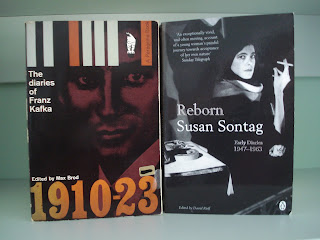


Stimulated by SS, I found Kafka’s diaries in a second-hand bookshop and have just started reading those. (I recently read Metamorphosis because my son mentioned it as an important book to him when he was young but grown-up.) I don’t have a handle on Kafka at all, but am already riveted by his diaries. He is, to put it mildiy, a miserable fellow. Sometimes it hard to tell whether a diary entry is just that, or an attempt at something he wants to write. His lack of belief in himself and his writing is well expressed in this sentence: “My doubts stand in a circle around every word.”

Here are two of my short stories: (I’ve included the first one because Prue liked it.)

Separations
When you have parents who don’t get on, and you are an only child, you learn some things. Angela learnt that she could often get what she wanted by playing them off against each other. The down side of that was that she never felt she could quite trust the stability of the situation. Her parents didn’t row, or at least not noisily, and they slept in the same bed, so it wasn’t embarrassing when her friends came over after school.

The worst thing was hard to describe; a kind of tension. It would vanish when she and one parent were together, cooking something, or watching television, or doing her homework, but when the other parent came into the room the air would turn cold and empty-feeling and she would know she had to be careful to not seem to favour one over the other, to spread herself evenly between them.

When her father told her he was leaving, he assumed she would stay with her mother and visit him on weekends; he’d get a flat not too far away, he said, so she could still see her friends. Having separated parents wasn’t anything unusual, but still, she was anxious. I’m thirteen, she wanted to say, I’m the one who’s supposed to change things, you’re the grownups you’re supposed to stay the same until, well, at least until I finish school.

They both went to a lot of trouble to tell her that it wasn’t her fault, she hadn’t done anything wrong. She knew that and she knew that parents always say that, she had known it since Valerie’s parents separated when she and Valerie were six, and there had been plenty of break-ups since then.

Once the separation actually happened, Angela noticed her father fading, gradually getting more and more hazy, seeing her less and less often, paying her less attention when they were together; something about having a new wife and baby. She didn’t mind, the new wife was a terrible fusspot, more concerned about her own makeup and clothes and that people might think Angela was her daughter, and that she was old enough to be mother to a teenager. When Angela got to university and struck Gertrude Stein in third year English Literature, she found an explanation of what happened with her and her father. “Little by little we never met again.” They did see each other occasionally, but they never met in any real sense, they never said more to each other than pleasant nothings. “How are you?” “Fine, thanks. And you?” “Oh, good.”

Being just Angela and her mother in the house was surprisingly relaxed and easy. There was the occasional man who stayed over, but never anything serious, and Angela herself even had boyfriends stay over once she was sixteen and that was never a big deal. Then Angela went off to university in Wellington and her mother sold the Wanganui house and moved to Otaki to live with a man who bred llamas.

Angela completed her first degree the same month that her boyfriend and her best friend broke her heart. Julie, her second-best friend took her off to spend the summer in midst of her own seven-sibling family. With partners, sundry extras like Angela, and children, there were nineteen people in and around the rambling house. Tents on the lawn. Bunks in the sleep-out. Julie and Angela shared a built-in veranda that had two single beds, end to end.

Christmas and New Year were a kind of family chaos that Angela had never known. No solitude. No silence. No pressure to do or be anything in particular, along with an expectation that everyone would lend a hand here and there while Julie’s mother orchestrated the whole. And everyone was responsible for their own stuff. “Leave it lying around and lose it,” Julie advised. “Leave it in your bag or on your bed and no-one will touch it.”

It didn’t take Angela long to notice cracks, jealousies, manipulations. They fascinated her. No-one, certainly not Julie, wanted to talk about any of that, it was like a river, all action and doing on the surface, surging sometimes, quietly pooling some-times, but with undercurrents pulling this way and that, unexpected eddies and blockages making confused and confusing ripples and waves, some of them powerful, none acknowledged.

One of the older brothers, Alan, was taken with her, Angela could tell. When he was around she stayed closed to Jill, mother-organiser.

In the first week of January, when Angela was beginning to think about extracting herself back into her own life, which she could at least bear to think about again, one of the children drowned in the river. The real river, the one flowing past the bottom of the long garden. Kevin was six, one of the kids that ran about all day doing kid-stuff, being hushed regularly by the adults.

Some wanted to know what happened, wanted to blame someone, a parent, an older child, someone. Others went quiet, comforting and being comforted. Two brothers dealt with the police. A sister-in-law and Julie dealt with the media. People swore and cried and went for walks in ones and twos and the departures started. Irritations and squabbles came to the surface. Angela left with the first wave, deciding for herself that her bed was more use to the family than her presence.

She stood in the bow of the ferry as it ploughed through Cook Strait, feeling the wind against her body, the spray not quite reaching her, and thought of her ex-boyfriend and her once friend together and saw that the hole in her life was quite a small hole and diminishing.


Home and Away
Time to go home. She thinks she knows where home is, and it’s not where her heart is, her heart is a tired, dry, shrivelled thing inside her. Home is that familiar place, that place where she can stand and know where thing are; Australia is that way, across the Tasman Sea, for South America she will need to turn east, towards the Pacific Ocean, south is Antarctica (yes, yes, Antarctica is always south). Almost everything else is north of where she stands when she is home. At night, looking up, she will be able to find the southern cross and work out half a dozen other star forms in relation to it. She knows the weather, whatever it is, will change, that there are spaces of countryside between cities and towns, that home is small and underpopulated except around its northern city, and both future-focused and backward-looking. Sooner or later she will run into people she knows, there will be friends who have drifted and friends who will fit right back into her life and she theirs.

She will go home and wear it like an old, comfortable coat, and rest. It will not be the rest that lasts until death, it will be rest to fit her for the restlessness that is just as familiar as home, the restlessness that will drive her on. This she knows, as well as she knows that for now her only option is to rest.

The volume of noise sinks. The helicopter has landed.