June 24, 2010

why write? why not read?

Why write? It’s the ongoing question. Sometimes I bore myself thinking about it, so I try not to think about it and just do it. Today it popped out of hiding as I was thinking about writing a new blog entry. “Because I have to,” is a silly answer, though it often enough comes to mind. Maybe it’s really, “because I want to.” If I want to I must think I have something (worthwhile) to say. What could that be? A particular way of seeing the world, perhaps. Maybe I read books by writers who write about writing in search of a better answer.

The daily writing diary has been stop-start jumpy. Days when I forgot, others when I just didn’t do it. Being sick with a cold was a credible excuse for only a couple of those days. Still, rambling away to myself about what I am writing — and not — is something I will carry on for July. Along with a new spurt of editing the novel that keeps slipping into the background.
I found and bought a second-hand copy of Strunk & White’s Elements of Style which I mentioned in my earlier post. Its “do this” and “don’t do this” approach is an antidote to a lot of writing about writing on the web, which is kind of wishy-washy.

Novels made it back into my reading. Alison Wong’s When The Moon Turns Silver, Paul Auster’s New York Trilogy (three short novels from the eighties), Lorrie Moore’s A Gate at the Stairs.


And a bit of new writing:

…the other side…
I try not to envy Maria. She’s my best friend, after all, and envy is such a corrosive emotion, not too many steps away from resentment, and you can’t be friends with someone you resent. Married to maybe, I’m sure many are, but not good friends with.

We’ve known each other for forty years, Maria and I, been through a lot together — my illness, her divorce, the horror of her son going into the army, the SAS, no less. Not to mention various financial crises, forced house sales, teenage children in various kinds of trouble. All history now. We talk sometimes about how things we lived through, like the ’81 Sprinbok tour and the bombing of the Rainbow Warrior, are the subjects of documentaries about the past. “That’s not history, that’s my life!” we want to say.

We haven’t always lived in the same city or even country, but it never stopped us keeping in touch. How old-fashioned writing and posting a letter with a stamp on it seems now.

It’s so easy to be romantic about something that isn’t and won’t be available to oneself, so easy to think “it must be wonderful to…” and it wouldn’t necessarily be, on a day to day basis,j so wonderful in its happening. But I do envy. Oh, I have my laptop, bless it, that takes me out and about in the world, but it’s not the same as living, as they say, in the bosom of your family.
“Here you go, Helen, here’s your call from Adelaide.” They’re very nice the staff here, mostly from the Pacific Islands, quietly spoken and pleasant

“Hello Helen, it’s so good to hear you.” Maria sounds tired. I can hear her grand-children in the background, arguing with their father by the sound of it. “That’s just started up. I’ll go into the other room and close the door.”

June 1, 2010

More writing, editing and reading

Story A Day May is finished. I posted 29 stories in 31 days. See one at the end of this blog entry.

Have finished the tense-edit of the current novel. One more chapter to write, this time with some of the early story of the mother, Shirley. I’m avoiding thinkng about what to do when it seems finished — apart from having Prue and some others read it. Publishing is an odd beast at the moment, with the big print-publishers looking for fashionable writers who’ll sell vast quantities of books and epublishers talking themselves up like mad and neither side really knowing anything about the future.

I just read an excellent book, Reading Like A Writer, by Francine Prose, a novelist with fourteen published novels, none of which I have heard of let alone read. It’s sub-title is, “a guide for people who love books and for those who want to write them.” She recommends Strunk and White’s The Elements of Style from way back and reading and analysing the best of writers, with lots of examples from Raymond Chandler to Chekhov. Katherine Mansfield is in there, and Gertrude Stein.

What now for daily writing? A writing diary I think, which may include bits of writing. A sort of keeping tabs on myself, not something to show people or put online. I’ll try that for a month and see where, if anywhere, it goes.
And it’s definitely time to read a novel.

Here’s the story:

June
June had been born in July and was grateful to have been named for her maternal grandmother and not the month of her birth. When she had suggested to her Uncle August that he could use his second name, the harmless John, he’d told her that his father had called him August and that was good enough for him, thank you. June was accustomed to her helpful suggestions being taken the wrong way. It was only the other day at work when Nigel had complained, yet again, about how put upon he was and how Keith and Shona took it for granted that he would clear away all their coffee mugs and she had said, ‘Leaving them there is a good alternative to being a martyr,’ and he hasn’t spoken to her since.

She doesn’t see much of her siblings these days. Not since their parents died. She had suggested, quietly and calmly, that they take turns at choosing something they wanted from their parents’ house until they didn’t want any more and Graham had said okay, he’d go first as the oldest and take everything in the china cabinet and Doris had screamed at him that alphabetical would be fairer and the whole cabinet-full was more than one thing and they had both turned and blamed her for the idea. ‘You always come up with a solution and it’s always a bad one,’ Doris had said and that really hurt her feelings and she ended up not even putting her dibs in for the piano, which was now gathering dust in Graham’s oldest’s spare room and she would definitely have started piano lessons.

Still, she had her pleasures. She liked to think of her small back garden as her courtyard. She had it just as she liked it, from the two metre long raised bed where she grew silver beet and lettuces and tomatoes and the occasional capsicum bush and a crop of broad beans over the winter, to the wisteria along the side fence. All her life she had wanted a garden with a wisteria and a flowering kowhai tree and this year the dwarf kowhai she’d found a space for in the corner had flowered at last. Two magnificent yellow blooms; she had learnt to use the macro setting on her new digital camera specially and now had them as a screen-saver that gave her a small thrill every time she woke up her computer.

The clothes line had been a challenge; there was something particularly domestic about a Hills Hoist that would have ruined the atmosphere of the whole area. It took a while, and she even considered the wickedness of using the dryer for everything and not having a clothes line at all, but in the end she came up with a solution. There was just room along the side of the house next to the driveway to the garage for a non-revolving foldaway that she didn’t actually have to fold away, she could get the car past it easily. The electrician who backed the corner of his van into it and made a significant dent just wasn’t paying enough attention.

No-one could look in to her courtyard. It was private. Occasionally she could hear a neighbour in their garden, but she liked that, as long as it was a background noise and not loud and intrusive. She got on well enough with her neighbours, it paid to, in case of a civil defence emergency or even an accident or heart attack or something. Not that she worried, if she had a heart attack or a stroke she hoped it would be a big one and take her out. She rather liked the idea of coping with the aftermath of an earthquake but not anything that lost her her independence.

The people who had just moved in next door were a bit noisier than she liked. There were a couple of young teens and a toddler and two parents, one man one woman, who both seemed to go out to work all day. It was no doubt a child-care baby; June had no opinion about whether that was a good or a bad thing, she’d never had children. A hysterectomy in her thirties had seen to that, and she never minded. She’d been with Gloria at the time.

So here she was, on her own and as happy as she had ever been. She sank into her chair and opened the Sunday paper.

May 17, 2010

Writing up a storm

In a funny kind of way I am writing up a storm at the moment. And having an extremely good time with it. A Story A Day for May is working out really well, because I am doing what I thought I would and taking a piece from my earlier 250-a-day project and finishing that for the day’s story. Sometimes that involves only a little light editing and a final line, sometimes it’s a major rework and a lot more text. I’ll add a couple to the end of this post.

And the other day, in the midst of running hither and yon to get a new back window put in my car (smashed it myself, by accident of course, closing it on a boot full of wood) I came up with a whole new book idea. Not that I’ve anything like finished the novel I am working on. The new idea would involve using some of the stories I am writing at the moment. No, not exactly a short story collection. More in a later post, when I have the idea better worked out.

I am managing to put some serious time into the current novel. It’s a matter of editing and rewriting at the moment. I like the story, it’s the writing that needs work!

I read the first volume of Susan Sontag’s letters, called Reborn and edited by her son, David Rieff. I can’t say anything about it because it’s my book club choice and some of my book club people read this blog. After we’ve had our book club discussion I’ll say more about this book.
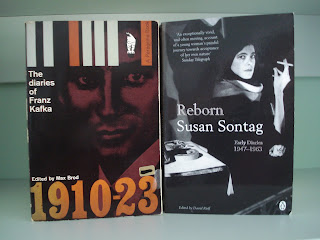


Stimulated by SS, I found Kafka’s diaries in a second-hand bookshop and have just started reading those. (I recently read Metamorphosis because my son mentioned it as an important book to him when he was young but grown-up.) I don’t have a handle on Kafka at all, but am already riveted by his diaries. He is, to put it mildiy, a miserable fellow. Sometimes it hard to tell whether a diary entry is just that, or an attempt at something he wants to write. His lack of belief in himself and his writing is well expressed in this sentence: “My doubts stand in a circle around every word.”

Here are two of my short stories: (I’ve included the first one because Prue liked it.)

Separations
When you have parents who don’t get on, and you are an only child, you learn some things. Angela learnt that she could often get what she wanted by playing them off against each other. The down side of that was that she never felt she could quite trust the stability of the situation. Her parents didn’t row, or at least not noisily, and they slept in the same bed, so it wasn’t embarrassing when her friends came over after school.

The worst thing was hard to describe; a kind of tension. It would vanish when she and one parent were together, cooking something, or watching television, or doing her homework, but when the other parent came into the room the air would turn cold and empty-feeling and she would know she had to be careful to not seem to favour one over the other, to spread herself evenly between them.

When her father told her he was leaving, he assumed she would stay with her mother and visit him on weekends; he’d get a flat not too far away, he said, so she could still see her friends. Having separated parents wasn’t anything unusual, but still, she was anxious. I’m thirteen, she wanted to say, I’m the one who’s supposed to change things, you’re the grownups you’re supposed to stay the same until, well, at least until I finish school.

They both went to a lot of trouble to tell her that it wasn’t her fault, she hadn’t done anything wrong. She knew that and she knew that parents always say that, she had known it since Valerie’s parents separated when she and Valerie were six, and there had been plenty of break-ups since then.

Once the separation actually happened, Angela noticed her father fading, gradually getting more and more hazy, seeing her less and less often, paying her less attention when they were together; something about having a new wife and baby. She didn’t mind, the new wife was a terrible fusspot, more concerned about her own makeup and clothes and that people might think Angela was her daughter, and that she was old enough to be mother to a teenager. When Angela got to university and struck Gertrude Stein in third year English Literature, she found an explanation of what happened with her and her father. “Little by little we never met again.” They did see each other occasionally, but they never met in any real sense, they never said more to each other than pleasant nothings. “How are you?” “Fine, thanks. And you?” “Oh, good.”

Being just Angela and her mother in the house was surprisingly relaxed and easy. There was the occasional man who stayed over, but never anything serious, and Angela herself even had boyfriends stay over once she was sixteen and that was never a big deal. Then Angela went off to university in Wellington and her mother sold the Wanganui house and moved to Otaki to live with a man who bred llamas.

Angela completed her first degree the same month that her boyfriend and her best friend broke her heart. Julie, her second-best friend took her off to spend the summer in midst of her own seven-sibling family. With partners, sundry extras like Angela, and children, there were nineteen people in and around the rambling house. Tents on the lawn. Bunks in the sleep-out. Julie and Angela shared a built-in veranda that had two single beds, end to end.

Christmas and New Year were a kind of family chaos that Angela had never known. No solitude. No silence. No pressure to do or be anything in particular, along with an expectation that everyone would lend a hand here and there while Julie’s mother orchestrated the whole. And everyone was responsible for their own stuff. “Leave it lying around and lose it,” Julie advised. “Leave it in your bag or on your bed and no-one will touch it.”

It didn’t take Angela long to notice cracks, jealousies, manipulations. They fascinated her. No-one, certainly not Julie, wanted to talk about any of that, it was like a river, all action and doing on the surface, surging sometimes, quietly pooling some-times, but with undercurrents pulling this way and that, unexpected eddies and blockages making confused and confusing ripples and waves, some of them powerful, none acknowledged.

One of the older brothers, Alan, was taken with her, Angela could tell. When he was around she stayed closed to Jill, mother-organiser.

In the first week of January, when Angela was beginning to think about extracting herself back into her own life, which she could at least bear to think about again, one of the children drowned in the river. The real river, the one flowing past the bottom of the long garden. Kevin was six, one of the kids that ran about all day doing kid-stuff, being hushed regularly by the adults.

Some wanted to know what happened, wanted to blame someone, a parent, an older child, someone. Others went quiet, comforting and being comforted. Two brothers dealt with the police. A sister-in-law and Julie dealt with the media. People swore and cried and went for walks in ones and twos and the departures started. Irritations and squabbles came to the surface. Angela left with the first wave, deciding for herself that her bed was more use to the family than her presence.

She stood in the bow of the ferry as it ploughed through Cook Strait, feeling the wind against her body, the spray not quite reaching her, and thought of her ex-boyfriend and her once friend together and saw that the hole in her life was quite a small hole and diminishing.


Home and Away
Time to go home. She thinks she knows where home is, and it’s not where her heart is, her heart is a tired, dry, shrivelled thing inside her. Home is that familiar place, that place where she can stand and know where thing are; Australia is that way, across the Tasman Sea, for South America she will need to turn east, towards the Pacific Ocean, south is Antarctica (yes, yes, Antarctica is always south). Almost everything else is north of where she stands when she is home. At night, looking up, she will be able to find the southern cross and work out half a dozen other star forms in relation to it. She knows the weather, whatever it is, will change, that there are spaces of countryside between cities and towns, that home is small and underpopulated except around its northern city, and both future-focused and backward-looking. Sooner or later she will run into people she knows, there will be friends who have drifted and friends who will fit right back into her life and she theirs.

She will go home and wear it like an old, comfortable coat, and rest. It will not be the rest that lasts until death, it will be rest to fit her for the restlessness that is just as familiar as home, the restlessness that will drive her on. This she knows, as well as she knows that for now her only option is to rest.

The volume of noise sinks. The helicopter has landed.

May 1, 2010

Bearing Fruit

Oh, the internet!

Now I have joined up for A Story A Day for May. http:storyaday.org/ Finish a short story every day (well, I have decided on six days a week, with a movable day off to accommodate the rest of my life.) Any length. As much or as little chat and/or support as one wants to take part in at the website. I might post the occasional story here. This will be my May version of 250-words-a-day. The point remains to keep myself writing new stuff, pushing myself into different points of view (hah!) and experimenting with tenses and generally playing around with the actual writing.

The Novel continues. Have completed the first extra chapter enough to insert it into the manuscript and am working on the second one (I think there will be three extra chapters in all, each expanding one of the secondary chapters.) Not as dissatisfied with the overall project as I was. Thank you Prue for encouragement.

On the reading front, I finished 2666. Worth the effort, I think, quite memorable, but not to everyone’s taste. When the Earth Turns Silver by Alison Wong came in my birthday pile. I really enjoyed it, some good insights into turn of the 19th/20th centuries Wellington and the Chinese community. It’s a story of tragic love of more than one kind and does that tricky thing of giving background history without undermining the story-telling. The Guernsey Literary and Potato Peel Society by Mary Ann Shaffers & Annie Barrows, also a birthday book, is a good book but not a great one. Told in letters from a variety of writers, who all actually write the same, its biggest flaw. I enjoyed reading it and learnt a lot about the German occupation of Guernsey in WWII, about which I was pretty ignorant.

I was moved to re-read Tillie Olsen’s Silences by its inclusion in a list of the 10 books a writer should read. (I didn’t recognise most of the other entries, was intrigued by this one being on the list.) It’s a collection of fragments and a wide range of quotes from other writers, plus transcripts of a couple of lectures she gave from notes. It’s an excellently argued treatise about women writers being diminished and ignored as well as full of ideas about what writers need in order to write. It was first published in 1980 and I remember reading it then. Here’s one of my very favourite quotes. Tillie Olsen is quoting William Blake:

“Blight never does good to a tree … but if it still bear fruit, let none say that the fruit was in consequence of the blight.”

April 12, 2010

Going somewhere, maybe

At the beginning of April I started taking a 250 word piece from March and adding 250 words to it. (The prospect of having 365 beginnings after a year was just too much.) That was okay. Unexciting, but okay. Some of the pieces I had written I didn’t remember at all. Then I decided I wanted to add a chapter to the Ann novel, so started doing that a bit a day, and I have got a chapter, though not one I am happy with yet. Still, it’s some of the way there, so I’ve put it into my novel ms. Then I moved into editing the next chapter, now chapter 4, and I’m really not happy with the whole novel. Not the story, I like the story a lot, it’s about the writing. I guess. I'm looking for a variation of my usual style, I think, but can't articulate it. I’ll keep gnawing away until something happens. The thing to not do, I tell myself, is stop trying, it's always easy to go on to other things, but I think the 250 words a day thing is showing me the benefits of keeping at it.

On the reading front, I am two-thirds of the way through Roberto BolaƱo’s 2666. A very unusual book in five parts and over 800 pages. I struggled in the middle to maintain interest, but Part 4 got me hooked back in. Strange, because Part 4 consists, not entirely, but mainly, of a detailed list of women who were raped and killed. No voyeurism, just facts, and names of policemen and a few other bits. A bit like a wordier Eliot Weinberger list (a lot wordier) it kind of builds up.

Previously read Hicksville, the graphic novel by Dylan Horrocks that has just been reissued by VUP. I read the original version from the Wellington Public Library. A comic about comics, at least in part. Also about New Zealand, and fitting in, or not, and a bunch of other things. There’s an art to ‘reading’ the visual part of graphic novels, which I don’t think I have quite got the hang of. Maybe I didn’t read enough comics as a child.

I have accumulated a great list of writers' blog, which I dip into now and then. Mostly they are interesting and well-written but they can become too much of a good thing. I get sick of them after a while. The best book blog I have found so far, because it is extremely varied (eg, includes notable pictures of books) and has really good writers is the New Yorker's book bench. Find it at:
http://www.newyorker.com/online/blogs/books/?xrai It will also lead you to the book club blog, where a noted author chooses a book to read and it gets talked about on the blog. This month it's Lorrie Moore's choice, which is David Vann's Legend of a Suicide, which I haven't read, but will.

March 22, 2010

Writers and Readers Week, Writing, Editing

As I expected, I loved Writers and Readers week at the International Arts Festival in Wellington. Highlights? Kamila Shamsi, for one. She's Pakistani and writes about wars on terror as an ongoing historical phenomenon, and how fear leads to accepting anything in the name of safety and security. Her novel Burnt Shadows is stunning. Also Neil Gaiman and Margo Lanahan both of whose books have large fantasy elements which I have enjoyed a lot. Audrey Niffenegger was fun, too, talking about Highgate Cemetery and her latest book. Geoff Dyer said he can’t think of stories so his books don’t behave the way readers expect. He admires Allan Hollinghurst, who does tell stories. Dyer looks for “unmediated experience” and tries to reduce the the distance between what he is writing and how he is writing it. I do love listening to writers talking about writing, even if I don’t always understand everything they say. I take notes. Another highlight was Philip Hoare, historian of the decadence of the nineteen twenties and, more lately, his current passion, whales. A very entertaining eccentric.

On my daily tasks I am doing better on writing 250 words a day than I am on editing my book. The latter needs longer periods of time I think, and my days have been very full lately. I am surprising myself with what comes out of my mind in the daily writing. At the end of March, I have decided, I will print all to date - about 40 beginnings - and read them and see what I want to add to and what I can mine for other purposes and review the whole exercise. I’ll keep doing it, might just change the parameters. Or not. Will report.

I’m changing my editing plan to available half days, of which my diary indicates there are some ahead. Interesting how recording these activities makes them concrete.

March 5, 2010

Reading the web, new writing & revising

I’ve been looking at lists and blogs about writing and writers. The best general writing blogs are via literary publications, like the New Yorker’s Book Bench http://www.newyorker.com/online/blogs/books/?xrail and the blogs at the LA Times http://latimesblogs.latimes.com/jacketcopy and the Guardian http://www.guardian.co.uk/books/booksblog. They all have links to other places and writers and act as useful filters (for me, anyway) so you can avoid spending hours trawling through individual author websites devoted mostly to bios and promoting their books, which is fair enough, but not what I want to read.

The New Yorker Book Bench is particularly good. It often links to non-nyer sites and, as is the nature of the internet beast, one thing leads to another. The trick is not to spend (waste?) too many hours on the intelligent musings of good writers. It can feel ‘educational’ but actually there is a law of diminishing returns. Lists of writing ‘rules’ and tips crop up often, some of them really useful, but in the end it’s each to her own. I really like to read what published writers say about their routines and habits, and there's plenty of that. Again, I look for the occasional tip that can be useful to me rather than rules to follow. For example, in spite of advice to the contrary I don’t plan to give up semi-colons altogether in favour of full-stops, but I might be more considered about where I use one. I might.

So, to create some discipline in my own writing I have set myself two daily tasks.

The first is to write 250 words of new fiction a day. This isn’t much, about two paragraphs, and can be done in fifteen or so minutes. I started about three weeks ago and so far have 21 short story beginnings. In a year I could have 365 short story beginnings. Yikes! Many of course will never go anywhere and I could try endings and middles in due course. Or even look back at earlier beginnings and add another 250 or so words. The word count is not exact, by the way, it’s not a matter of stopping at 250, it’s that once this number is reached I am ‘allowed’ to stop. It is interesting to have to dredge up an idea/ character/ bit of plot from scratch and get something on the page. Occasionally I surprise myself.

The other task I am setting myself is to spend at least an hour a day revising the novel I first-drafted last November. This is proving to be a major undertaking, which I am enjoying more than I expected. There have been lots of time and other detail issues to sort out, and now I am concentrating on tenses. I want to use present tense a lot and this is tricky. Will write more about this in a later post.